

01 — Overview
What was built
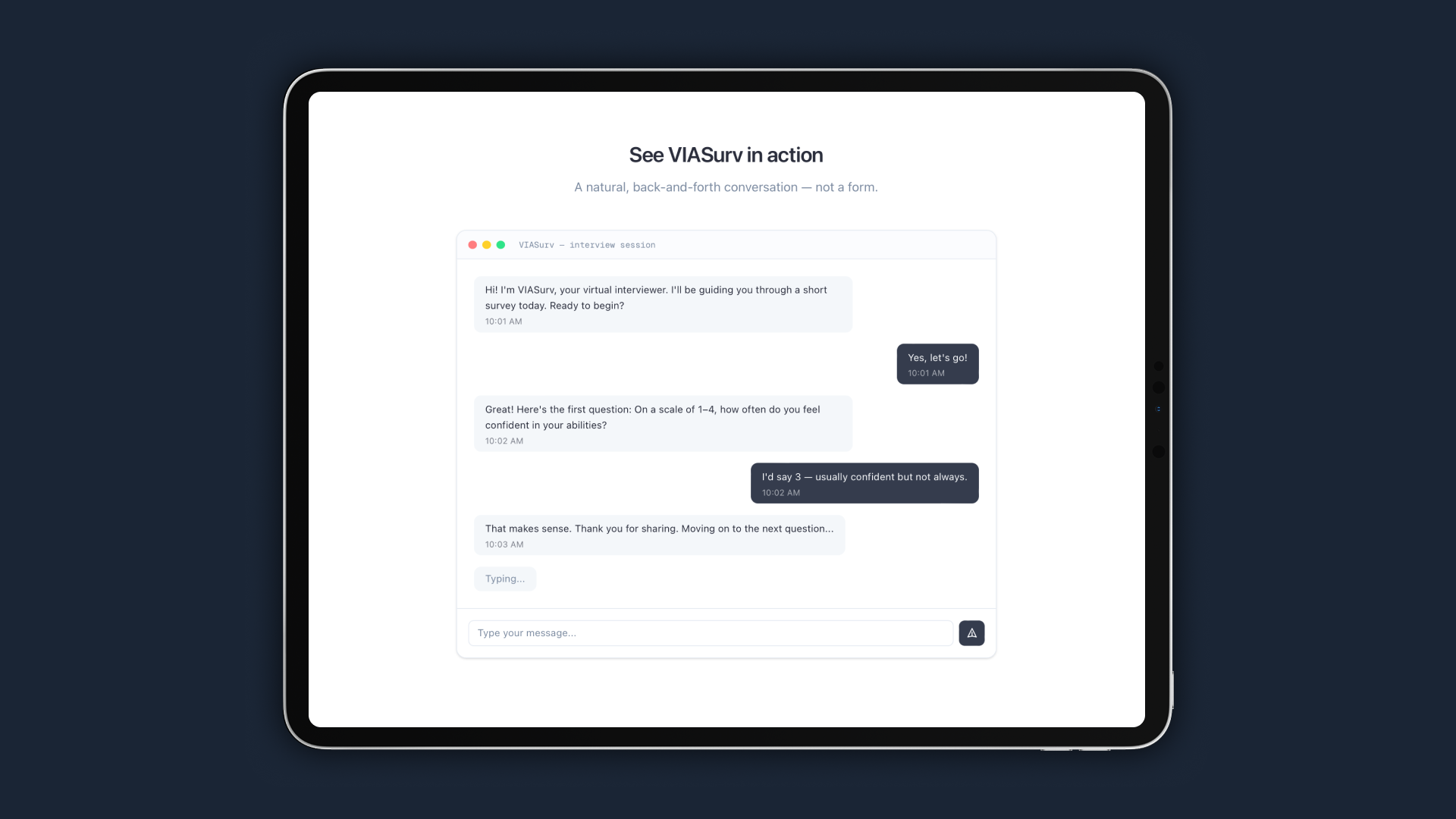
Traditional survey tools treat every respondent identically — a fixed script, no ability to probe an interesting answer, no natural conversational rhythm. VIASurv challenges that assumption with an AI-powered interviewer that can run both standardized scripts and adaptive, conversational interviews — across chat and voice — listening, adapting, and following up in real time.
The platform runs interviews in two styles — conversational (adaptive, AI-driven follow-ups) and standardized (a fixed, researcher-authored script) — across both chat and voice. The voice mode is powered by OpenAI's gpt-realtime-mini for low-latency, speech-to-speech conversation, so a session feels less like filling out a form and more like a real conversation with a knowledgeable interviewer.
I co-founded VIASurv with Kaidar Nurumov, a PhD candidate in Survey and Data Science at the University of Michigan. I led all software development across the frontend, backend, and AI integration.
02 — Research
Understanding the problem space
The starting point was a genuine research gap: qualitative survey methods are expensive and hard to scale. Semi-structured interviews yield rich data, but they require trained human interviewers and can't be deployed at scale. Existing survey platforms — Qualtrics, Typeform, Google Forms — are scalable but rigid, incapable of probing unexpected answers or adapting their line of questioning in real time.
Key Insights
- Researcher Needs: Flexibility to capture nuanced, open-ended responses without hiring a team of interviewers; structured export formats usable in downstream analysis.
- Respondent Experience: Survey fatigue is real — participants disengage from long, static forms. Conversational interfaces feel lower-effort and yield richer answers.
- Gap in Existing Tools: No mainstream platform combined adaptive AI-driven questioning with multi-modal collection across chat and voice in a single product.
Usability Testing
I conducted usability testing sessions with participants using the voice interviewer feature, observing where respondents hesitated, what caused confusion in the conversation flow, and how well the voice model handled varied speech patterns and accents. Findings directly informed iteration on the conversation flow and the pacing of the interviewer's responses.
Functionality Requirements
- Multi-modal collection: Conversational and standardized interviews, delivered over both chat and voice, within a shared survey schema.
- Adaptive questioning: the interviewer generates follow-up questions based on prior answers rather than following a fixed script.
- Session integrity: Robust session tracking so partial responses are preserved and resumable.
- Researcher dashboard: Clean export and review of collected responses for downstream analysis.
03 — Product
How it works
A single survey definition powers every format — conversational or standardized, chat or voice — so a researcher authors a study once and it runs consistently across all of them. Conversational interviews adapt their follow-ups to each answer; standardized ones hold to a fixed script for comparable, structured data.
Voice and chat are both first-class. The voice mode runs on OpenAI's gpt-realtime-mini, a speech-to-speech model that listens and responds directly in real time, for a fluid, low-latency conversation that feels like talking to an attentive interviewer rather than filling out a form.
Behind the scenes, sessions are tracked so partial responses are preserved and resumable, and everything respondents share flows into a researcher dashboard built for clean review and export.
04 — Project Status
Where it stands
VIASurv is an ongoing project. It's a working, deployed platform — not a prototype — and we're currently in the data-collection stage, with a formal study to validate the approach planned next.
What's in place so far
- A deployed platform running both conversational and standardized interviews across chat and voice.
- A real-time voice interviewer built on OpenAI's gpt-realtime-mini, tried with real participants in early usability sessions.
- End-to-end ownership of the full stack, from data model and backend through the real-time interview experience.
- A researcher dashboard for reviewing and exporting collected responses.
What's next
- Running data collection at scale, then analyzing whether conversational interviews yield richer responses than standardized ones.
- Hardening the real-time experience for graceful degradation under network latency.