

01 — Overview
What was built
Traditional 3D printing interfaces suffer from a critical gap: operators have limited real-time visibility into the print process and no meaningful way to intervene remotely. I led the design and development of an AR system that addresses this directly, using the Microsoft HoloLens 2 to create an immersive digital twin of the printer, visible and controllable in mixed reality.
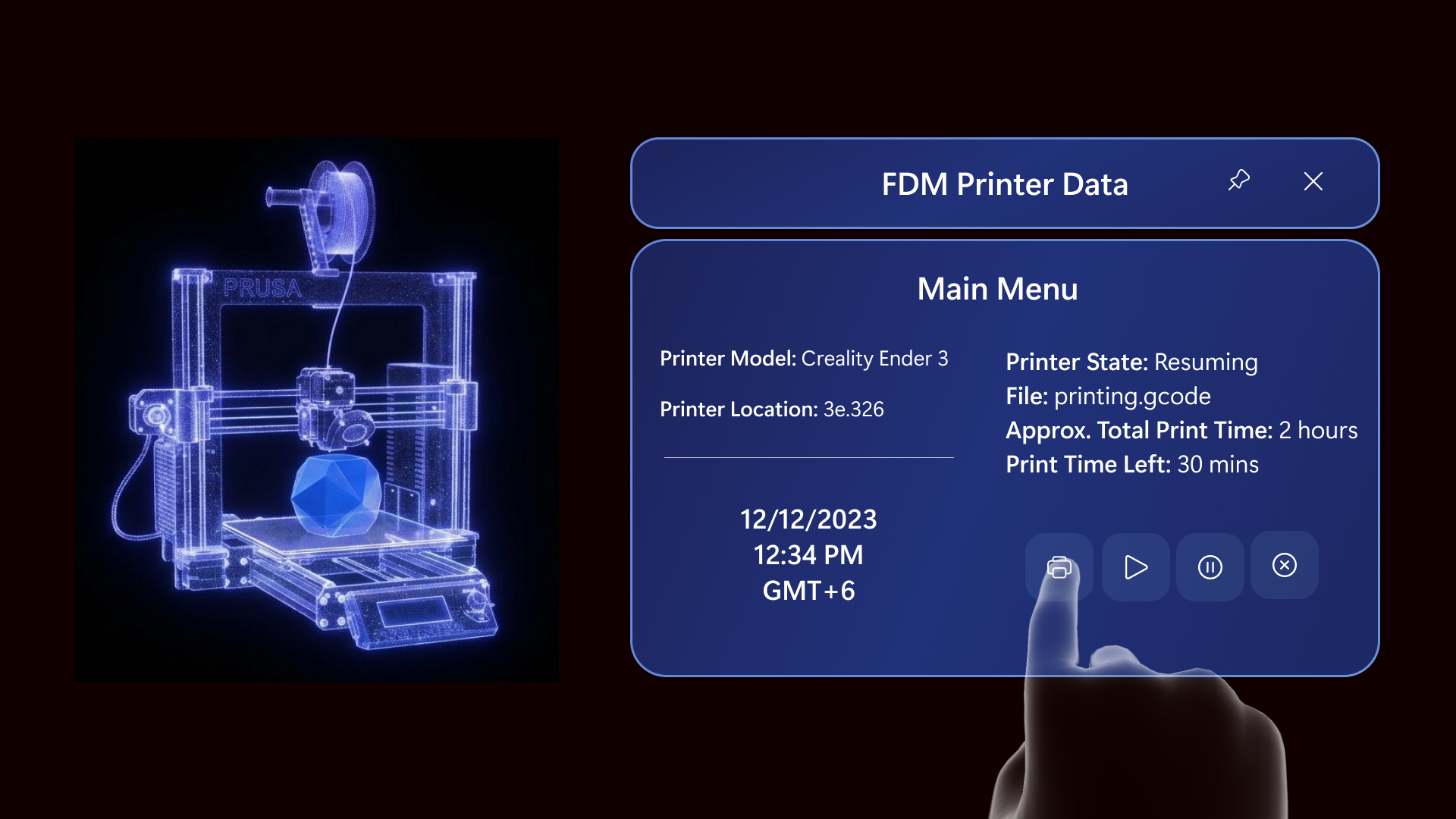
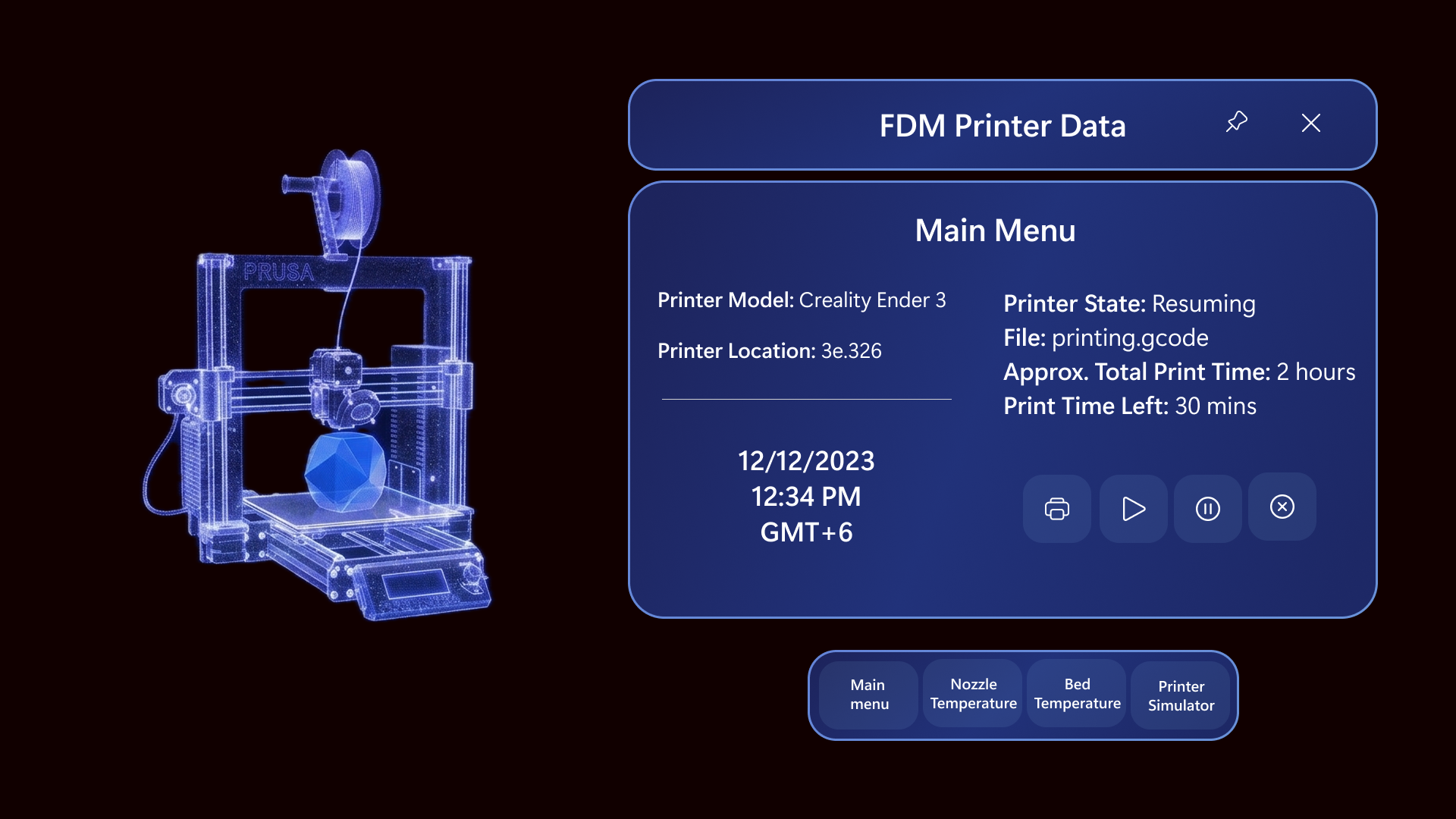
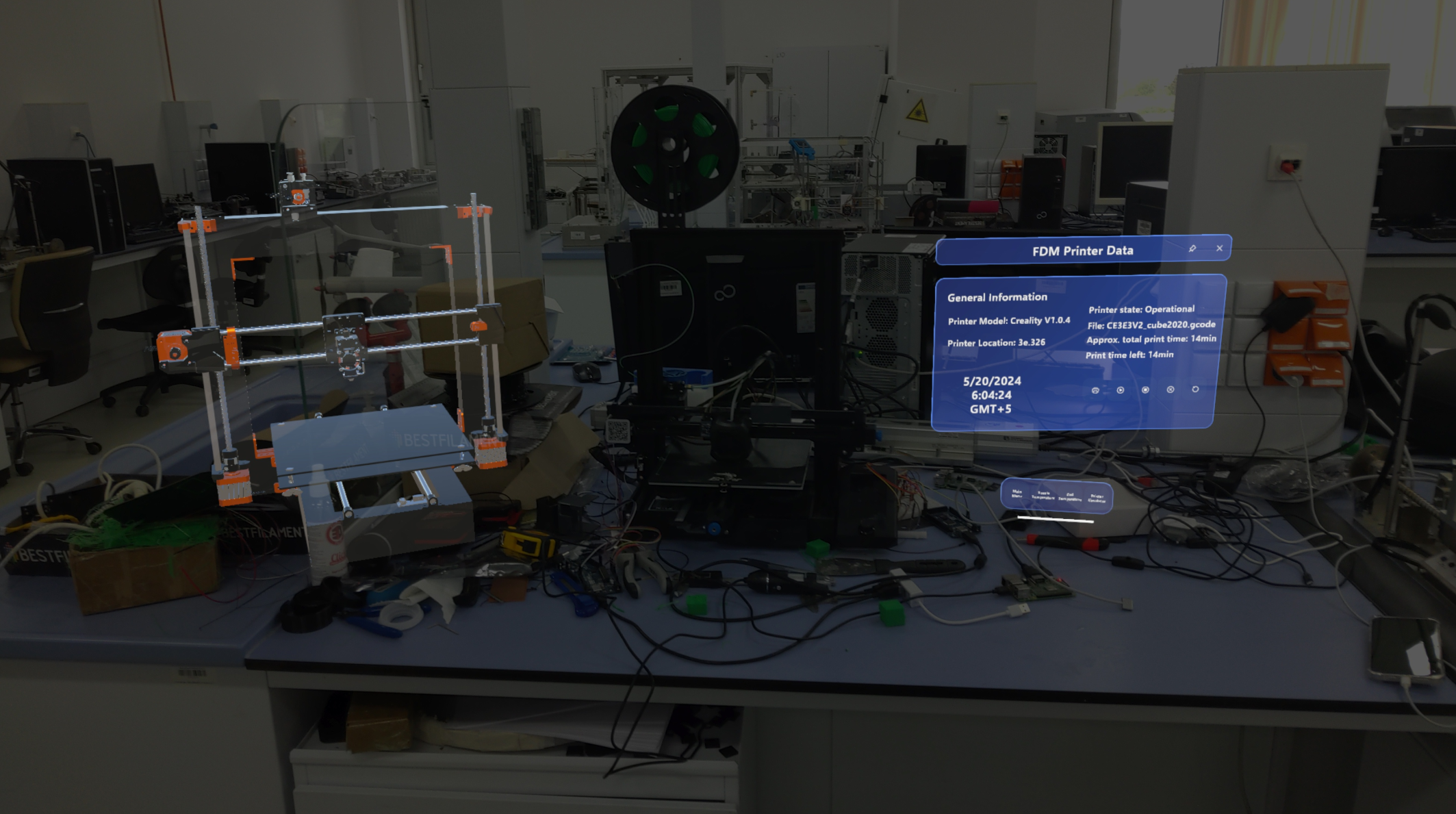
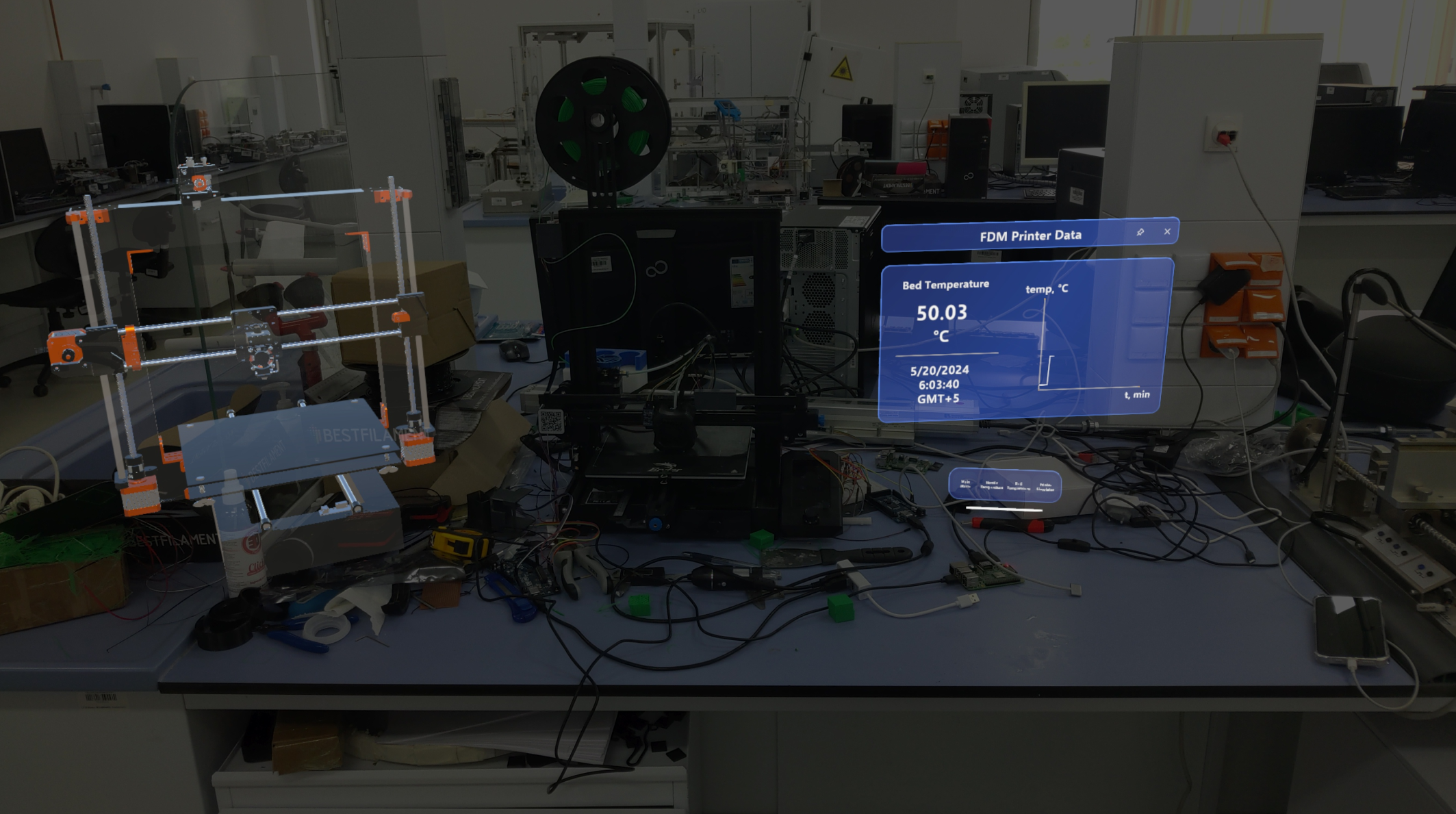
The proof-of-concept system overlays live process data — temperature, filament usage, print progress — directly onto the physical printer, and lets operators start, pause, or stop the print through AR interface controls.
02 — Research
Understanding the problem space
Prior to development, I conducted a literature review, semi-structured interviews with practitioners, and a competitive analysis to establish a clear understanding of operator needs and current tool limitations.
Key Insights
- User Needs: Real-time data visualization, minimal latency, secure access, and simplified remote control.
- Existing Solutions: Applications such as OctoPrint offer web-based monitoring, but AR integration remains limited.
- Competitive Analysis: OctoPrint, MagicHand, and MIT Media Lab's AR-for-AM work each fell short — none combined immersive interaction with real AM workflows.
Functionality Requirements
- Authentication: Restricted access to authorized users.
- Real-Time Monitoring: Displays parameters like temperature, time, and filament usage.
- Simulation: Visualizes the AM process in real time.
- Control Interface: Enables start, pause, and stop remotely.
03 — Development
How it was built
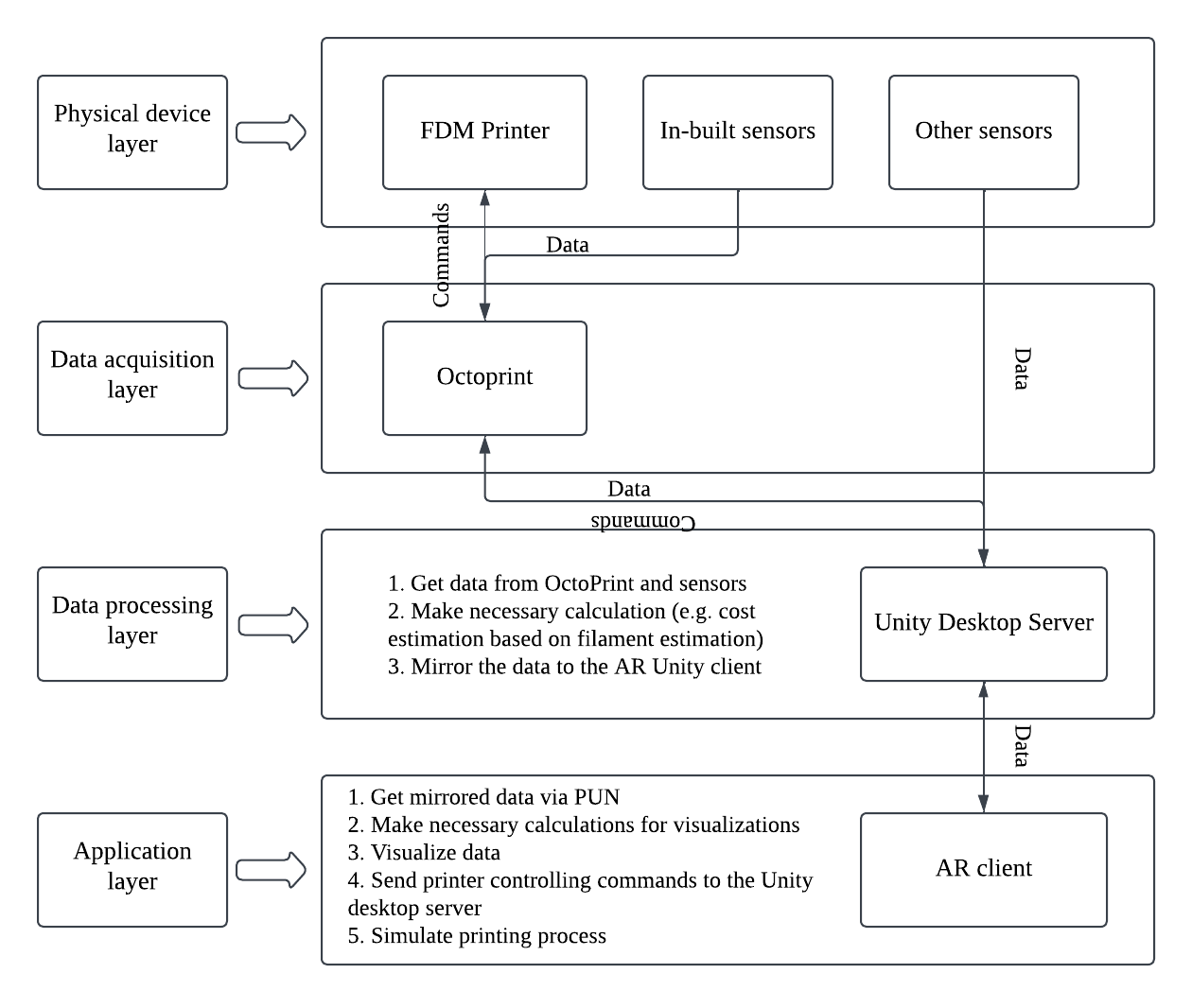
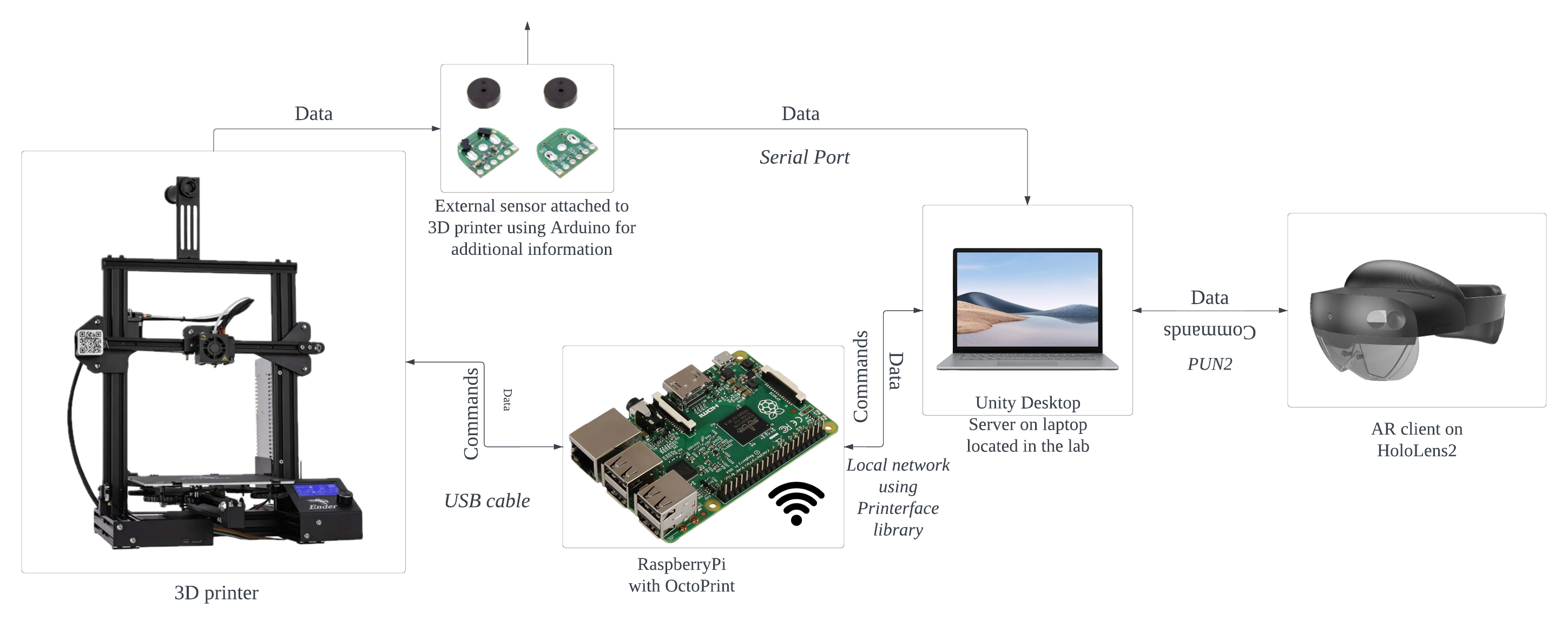
The system runs across four layers: physical (the FDM printer), data acquisition (OctoPrint + Raspberry Pi), data processing (Unity desktop server), and application (HoloLens 2 interface). Data flows from printer to headset in near real-time via Photon Unity Networking (PUN2).
The UI was built using the Mixed Reality Toolkit (MRTK) and Microsoft's design language for AR, with a deliberate focus on simplicity and learnability — a digital twin visualization of the printer, interactive control buttons, and a live parameter display panel.
Designing for AR meant navigating real hardware constraints: HoloLens 2's field of view, gesture-recognition reliability, and the latency introduced by the PUN2 networking layer.
04 — Outcome
What it achieved
This project produced a working proof of concept that demonstrates the viability of AR-assisted remote monitoring for additive manufacturing. The prototype surfaced capabilities like real-time print simulation and remote machine interaction that are typically inaccessible without physical presence on the lab or factory floor.
Transmission benchmarks showed strong performance at the OctoPrint layer (avg. 0.016 ms, σ ±0.006 ms), with Unity-to-HoloLens latency averaging 936 ms — a baseline for future iterations. The architecture's modular design suggests a viable path toward scalability across AM devices, and points toward a longer-term vision of digital twin integration.
05 — Reflection
What I learned
This project was my first experience with AR systems. Designing and developing across physical and virtual domains required balancing technical and design constraints simultaneously — field of view, latency, and data acquisition each shaped decisions in ways I hadn't anticipated.
Grounding the work in research was essential from the start. Stakeholder interviews surfaced the functional requirements, while technical exploration defined what was actually feasible. Drawing on literature around cyber-physical systems and HCI kept the system user-centered rather than purely engineering-driven.
If I revisited this project, I would spend more time identifying lower-latency data channels, and push further into multi-user co-presence — giving multiple operators a shared AR view for genuinely collaborative remote monitoring.